














Allen, Naomi E., et al. “Lifestyle and Nutritional Determinants of Bioavailable Androgens and Related Hormones in British Men.” Cancer Causes & Control, vol. 13, no. 4, 2002, pp. 353–63. doi:10.1023/A:1015238102830. https://pubmed.ncbi.nlm.nih.gov/12074505/
If your energy has crashed, your libido is not what it used to be, or you are putting on weight despite training, you might be wondering how to increase testosterone and whether low T is the cause.
The internet is full of supplements and boosters that promise quick fixes. Some help, many do not, and a few are not safe.
Here we break down the proven natural ways to boost testosterone, the medical options available in the UK, and how to avoid wasting time and money on shortcuts that do not deliver.
Key takeaways
- Testosterone boosters are widely advertised, but most lack solid evidence.
- Zinc, vitamin D, ashwagandha and fenugreek can help promote healthy testosterone levels, but they are not a substitute for lifestyle changes or clinician-led treatment.
- Healthy lifestyle changes, such as losing weight, reducing stress, quitting smoking, and eating a balanced diet, can support testosterone levels.
- Some men need medical support to get their testosterone levels back to a healthy range, in the form of testosterone replacement therapy (TRT).
- The first step is checking your T levels with an at-home blood test.

Why is testosterone important?
Testosterone is the main male sex hormone. It fuels libido, muscle growth, strength, mood, and energy. When levels dip, the impact shows up everywhere, in the bedroom, in the gym, and in daily life.
Common symptoms of low testosterone include:
- Low sex drive and weaker erections
- Persistent fatigue and poor recovery
- Muscle loss and increased body fat
- Hot flushes and sweats
- Low mood, brain fog, or poor focus
- Weight gain, especially around the waist
- Enlarged breast tissue (gynaecomastia)
Untreated low testosterone is linked with broader health risks like higher rates of osteoporosis, type 2 diabetes, cardiovascular disease, and mood disorders, plus a lower quality of life. Some studies also suggest a possible link with dementia risk.
Supplements to increase testosterone
“Testosterone boosters” are widely advertised, but most lack solid evidence. A review of 50 top-selling products found only 24.8% had any evidence of increasing testosterone, 10.1% had data showing a decrease, and 61.5% had none at all. Many also exceeded safe vitamin and mineral upper limits.
Which supplements might help testosterone levels?
While there’s no strong evidence that so-called testosterone boosters can dial up your T levels, the following supplements can be helpful if your blood tests or diet show a gap. But they are not a substitute for lifestyle changes or clinician-led treatment.
- Zinc: Even mild zinc deficiency can reduce testosterone, and replacing zinc can bring levels back toward normal. The right dose depends on your diet and labs.
- Vitamin D: In one randomized trial of men with low vitamin D, taking 3,332 IU daily for a year raised average testosterone from about 10.7 to 13.4 nmol/L, while the placebo group did not change. If your vitamin D is already normal, benefits are less likely.
- Ashwagandha and fenugreek: A systematic review of 32 randomised trials of herbs and testosterone levels found the most consistent testosterone increases were with ashwagandha and fenugreek, though studies are small, mixed in quality, and the benefit may be indirect. See our guide on whether ashwagandha increases testosterone for more detail.
How to boost testosterone naturally
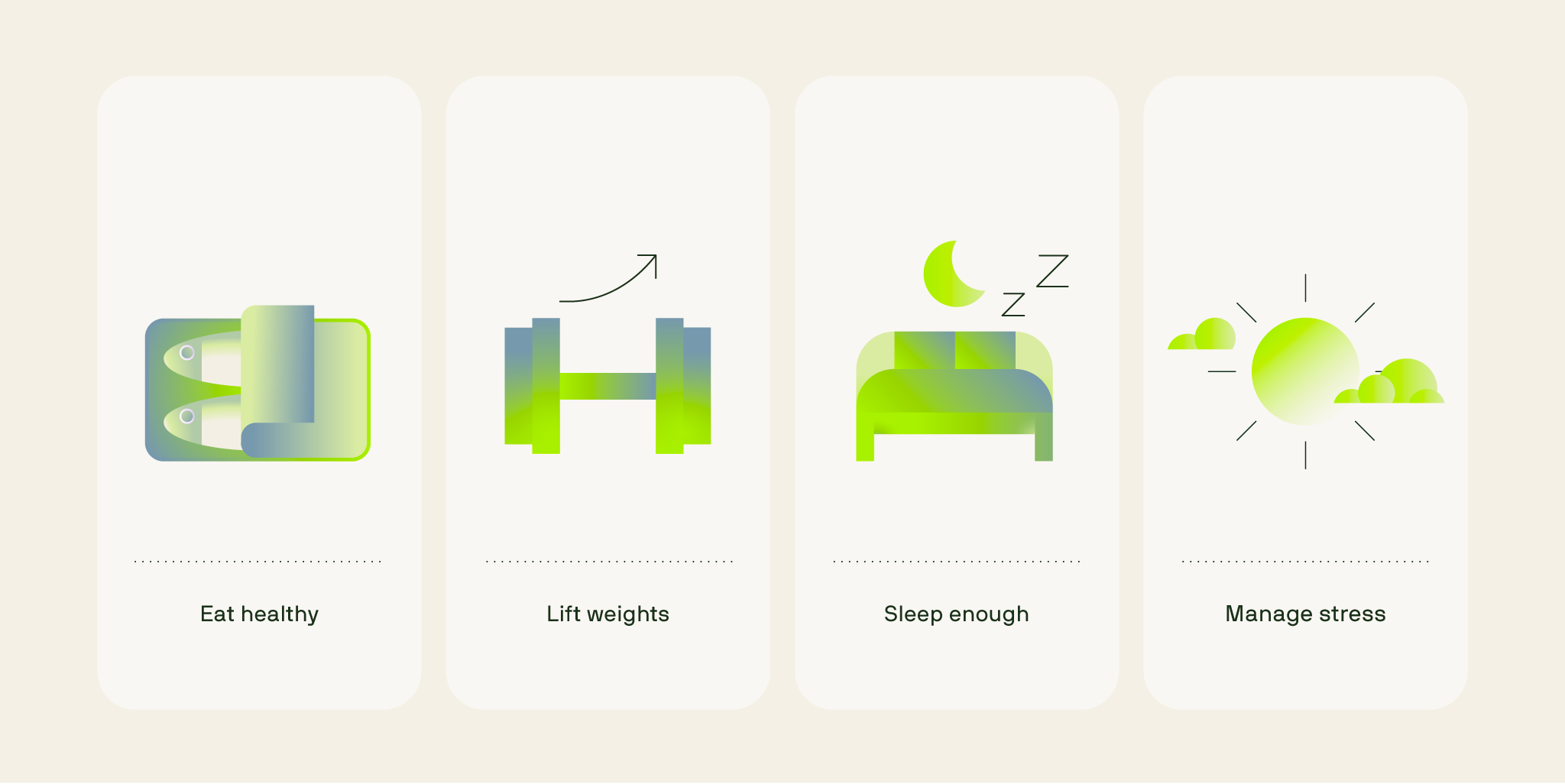
The most reliable way to naturally increase testosterone is through consistent lifestyle changes. There are no shortcuts, but the following are all backed by evidence:
- Lose excess weight. Obesity is strongly linked to lower T. Men with a BMI of 30 or above have around 30% lower testosterone than lean men. Fat loss is one of the most effective natural ways to raise levels.
- Lift weights and include compound movements. Regular resistance training supports healthy testosterone. Compound lifts such as squats and deadlifts recruit large muscle groups and prompt a stronger hormonal response than isolation exercises. HIIT (high intensity interval training) is also effective as it supports fat loss, reducing aromatase activity and oestrogen conversion. Avoid overtraining: excessive exercise without adequate recovery raises cortisol and can blunt testosterone.
- Sleep 7 to 9 hours. Just one week of restricted sleep cut daytime testosterone by roughly 10 to 15% in healthy men. Sleep is one of the most underrated levers for hormone health.
- Keep dietary fat balanced. Very low-fat diets are associated with small reductions in total and free testosterone. Focus on healthy fats and foods that support testosterone production rather than cutting fat entirely.
- Cut back on alcohol. Chronic alcohol use lowers circulating testosterone in men by raising oestrogen and suppressing the hormonal signals that tell the testes to produce testosterone.
- Stop smoking. Testosterone tends to be higher in non-smokers. If you smoke, stopping is one of the clearest lifestyle steps you can take for hormone health.
- Manage stress. Persistently high cortisol can suppress testosterone over time. High caffeine intake can also raise cortisol, so limiting consumption, particularly in the afternoon, is worth considering.
Can medications affect testosterone levels?
Lifestyle is not the only factor. Certain medications can contribute to lower testosterone as a side effect, including opioid pain medications, some antidepressants and statins. This does not mean you should stop or change any medication without medical guidance. It is worth flagging your full medication history during a consultation, as this can affect both diagnosis and treatment decisions.
Medical treatments to boost testosterone
Before considering medication, we recommend optimizing sleep, diet, and alcohol intake, as these heavily influence testosterone levels.
While lifestyle changes can help, some men need medical support to get their testosterone levels back to a healthy range. If symptoms point to low T, the first step is proper testing.
In the UK, the British Society for Sexual Medicine recommends treatment for men with symptoms and testosterone levels consistent with testosterone deficiency. During treatment, it suggests aiming for a testosterone level between 15 and 29 nmol/L.
With Voy you can order a fast, finger-prick blood test to do at home. A clinician reviews your results, confirms whether your testosterone is low, and advises on next steps without the usual waiting rooms.
If your blood tests confirm low T, testosterone replacement therapy (TRT) is a highly effective option.
A stronger, sharper you
Get your energy, drive and strength back, with a tailored testosterone service plan built by leading TRT doctors.
Effective personalised medication
Access to expert clinical team
Regular health monitoring
All-inclusive subscription - no extra costs
Why does the cause of low testosterone matter?
Not all low testosterone has the same root cause, and knowing the difference shapes which treatment makes sense.
In some men, the testes themselves are not producing enough testosterone. This is called primary hypogonadism. In others, the testes are capable of producing testosterone but are not receiving the right signals from the brain, specifically from the pituitary gland. This is called secondary hypogonadism. A blood test that checks testosterone alongside LH and FSH can help identify which applies to you.
For secondary hypogonadism in particular, treatments that stimulate the body's own testosterone production, can be an option worth discussing with your clinician alongside or instead of TRT.
What is testosterone replacement therapy (TRT)?
TRT works by restoring testosterone to a healthy range, reversing many symptoms. Unlike “testosterone boosters” sold online, TRT uses regulated medicines prescribed by clinicians.
Forms of TRT available in the UK:
- Gels daily: needle-free, easy to adjust, require consistent daily use and care to avoid skin-to-skin transfer.
- Short-acting injections (enanthate): normally given twice weekly
- Long-acting injection (testosterone undecanoate): given in clinic about every 10–14 weeks.
- Mixed-ester injection (Sustanon): normally given twice a week but can be given less frequently such as once every 1 -2 weeks.
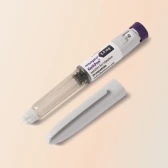
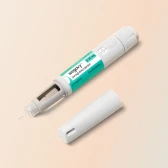
- Pellets/implants: placed under the skin every few months, harder to fine-tune so less common.
There's no oral testosterone available in the UK.
For those using injectable TRT, understanding how and where to inject testosterone can make the process smoother and more comfortable.
TRT at Voy
We focus on the most popular, well-studied, and highly effective options in UK practice:
- Injections - most effective form of treatment
- Daily topical treatment - for patients who are afraid of needles
Feeling drained and unfocused?
It might be low testosterone. Get answers fast with an at-home blood test.
Is it safe to boost testosterone levels?
Yes. When prescribed, monitored by clinicians, and done with the right plan, TRT is safe.
Testosterone is a controlled drug in the UK and is only available on prescription. Buying testosterone or anabolic steroids online or without a prescription is unsafe and often illegal. Misuse can suppress your body’s own testosterone production and harm fertility, heart, and liver health.
At Voy, we use regulated medicines and a secure supply chain. Black-market products, by contrast, are often low quality, with around 36% counterfeit and 37% substandard. We keep TRT treatment safe with regular blood tests, dose adjustments, and checks on key health markers like haematocrit, PSA, cholesterol, liver, kidney, weight and heart health. With us, you get holistic care, not just testosterone management.
Getting started with TRT
TRT is safe, effective and can be life-changing for men with low testosterone. With the right monitoring and medical support, most men can expect significant, lasting benefits.
Wondering if low testosterone is holding you back? Take our short quiz to see if TRT could help you get back to feeling your best.